Mrs. Stewart's Class
  • Home
  • AT Geography & Field Research
    • AT Geo: Daily Agenda
    • Geography 101: Intro to Geography
    • Unit 1: Inequalities
    • Unit 2: Demographics
    • Unit 3: Agriculture, Food & Health >
      • Community Health Webquest >
        • Water-borne pathogens
        • Vector-Borne Diseases
        • Pandemics
    • Unit 4: Urban Realm
    • Fieldwork
    • Country Portfolios
    • Geography Careers & Programs
  • World History 9
    • Daily Agenda - WH9
    • Unit 0: Thinking Like a Historian
    • Unit 1: Foundations of Civilizations
    • Unit 2: Revolution
    • Unit 3: Conflict
    • Unit 4: Globalization & Global Issues >
      • World History Voices Project - Students Digital Products
  • Social Studies/History Resources
  • AP Human Geography
    • Daily Agenda-APHG
    • APHG Unit 1: Geography: Nature & Perspectives
    • APHG Unit 2: Population & Migration
    • APHG Unit 3: Culture
    • APHG Unit 4: Political Geography
    • APHG Unit 5: Agriculture & Rural Land Use
    • APHG Unit 6: Industrialization & Economic Development
    • APHG Unit 7: Cities & Urban Land Use
    • APHG Exam Review
  • Free Time & Games
  • Current Events & Global Issues
  • About
  • Contact
  • Grade 7 Individuals & Societies
    • Grade 7 Daily Agenda
    • Grade 7 Weekly Homework
  • Grade 8 Individuals & Societies
    • Grade 8 Daily Agenda
    • Grade 8 Weekly Homework
  • CI MS Service-Learning
  • Photo Blog
  • SAS MS GIN Club
World History 9: Daily Agenda

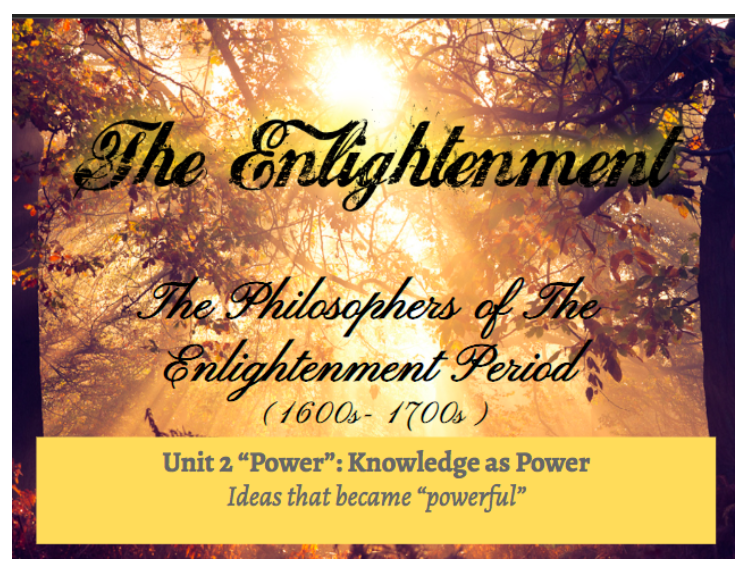
Power of Ideas: The Enlightenment -- A webquest for research

11/12/2018

 
Picture

Webquest Tasks:

Today you will follow a series of tasks to look at the European Enlightenment Era.  You will be reading some articles, watching some videos--and of course, taking notes on the various resources as they help provide information and insight into the questions we are seeking answers to in Table 3. 

For today's class, you should focus on the guiding questions provided for each of the steps below -- use these questions to guide your webquest into how ideas sparked revolutionary changes in society.  Because this will involve a couple of videos, please be sure to use headphones so that you do not disturb your classmates. If you do not have headphones, you can try using Closed Captions to read the script (or play it very very quietly... shhh!)

Step 1: Learn about the Enlightenment

Guiding Questions for Step 1:
  • What ideas came from the Enlightenment?​
  • Why were these ideas being shared and discussed during this time period so “powerful”?
​Use the following source to help you find answers to these questions:
  • ​ABC-CLIO: The Enlightenment  (Username: sastigers    Password: sastigers)​
    • ​​​Take notes on any information that helps answer one or more of the questions above.
    • Be sure to record the source title, etc. -- Big hint: ABC-CLIO provides the full MLA citation at the bottom of the page. Just copy it & paste! Easy!
    • Add QCI (especially "Insights"-- what do you now now about the Enlightenment? Which question(s) does this help you to answer? 

STEP 2: Pick 2 philosophers from the list below and watch one of the videos

Guiding Questions for Step 2:
  • What were the social, political, economic and moral issues that the enlightenment philosophers pointing out about society?
  • What were the various philosophers' views on human rights?
  • What were these philosophers say or write about that would get people thinking about the social, political and economic conditions they were living in at the time?
  • How could ideas such as theirs spark revolutionary changes within society?
  • What similarities/differences are there between the ideas of the enlightened philosophers?​​
    • You will pick two philosophers from the videos below.
    • Watch the video and take notes--add notes in your Table 3 document.
    • Be sure to record the source title, etc.
    • Remember to take notes only if it helps you answer questions. ​​
    • Add QCI (especially "Insights"-- what do you now now about the Enlightenment? Which question(s) does this help you to answer? 

STEP 3: Take more notes on your 2 selected philosophers 

Guiding Questions for Step 3:
Click on their names below and it will take you to another source provided. This helps with "corroboration" -- ensuring your ideas are backed up by more than 1 source. 
  • Bacon
  • Descarte
  • Jefferson
  • Hobbes (video)
  • Locke
  • Montesquieu
  • Machiavelli  (document)
  • Newton
  • Paine
  • Rousseau
  • Smith
  • Voltaire
  • Wollstonecraft (female philosopher)

Exit Ticket:
​Pick a 3rd philosopher... make note of which one you want to research for HW...

Homework: Step 4: research 1 more Enlightenment philosopher... 

For homework, take notes on 1 more philosopher (from the list above)--be sure you have 2 different sources for this philosopher (you can use any of the sources provided above --or search for your own reliable source.

You should be able to come to next class with notes on 3 different Enlightenment philosophers and your notes for each are from 2 different sources.  


​
​Next class block... we will begin considering the following question in class:
  • What was the consequences (intended and unintended) of their ideas being shared among society?
  • Which philosophers were more influential with their ideas?

Comments are closed.

    Mrs. Stewart's Course

    You'll find a daily agenda posted here for each day that class meets

    Archives

    January 2026
    May 2020
    April 2020
    March 2020
    February 2020
    January 2020
    December 2019
    November 2019
    October 2019
    September 2019
    August 2019
    May 2019
    April 2019
    March 2019
    February 2019
    January 2019
    December 2018
    November 2018
    October 2018
    September 2018
    August 2018
    May 2018
    April 2018
    March 2018
    February 2018
    January 2018
    December 2017
    November 2017
    October 2017
    September 2017
    August 2017
    May 2017
    April 2017
    March 2017
    February 2017
    January 2017
    December 2016
    November 2016
    October 2016
    September 2016
    August 2016

    Categories

    All

    RSS Feed

Powered by Create your own unique website with customizable templates.
  • Home
  • AT Geography & Field Research
    • AT Geo: Daily Agenda
    • Geography 101: Intro to Geography
    • Unit 1: Inequalities
    • Unit 2: Demographics
    • Unit 3: Agriculture, Food & Health >
      • Community Health Webquest >
        • Water-borne pathogens
        • Vector-Borne Diseases
        • Pandemics
    • Unit 4: Urban Realm
    • Fieldwork
    • Country Portfolios
    • Geography Careers & Programs
  • World History 9
    • Daily Agenda - WH9
    • Unit 0: Thinking Like a Historian
    • Unit 1: Foundations of Civilizations
    • Unit 2: Revolution
    • Unit 3: Conflict
    • Unit 4: Globalization & Global Issues >
      • World History Voices Project - Students Digital Products
  • Social Studies/History Resources
  • AP Human Geography
    • Daily Agenda-APHG
    • APHG Unit 1: Geography: Nature & Perspectives
    • APHG Unit 2: Population & Migration
    • APHG Unit 3: Culture
    • APHG Unit 4: Political Geography
    • APHG Unit 5: Agriculture & Rural Land Use
    • APHG Unit 6: Industrialization & Economic Development
    • APHG Unit 7: Cities & Urban Land Use
    • APHG Exam Review
  • Free Time & Games
  • Current Events & Global Issues
  • About
  • Contact
  • Grade 7 Individuals & Societies
    • Grade 7 Daily Agenda
    • Grade 7 Weekly Homework
  • Grade 8 Individuals & Societies
    • Grade 8 Daily Agenda
    • Grade 8 Weekly Homework
  • CI MS Service-Learning
  • Photo Blog
  • SAS MS GIN Club