Mrs. Stewart's Class
  • Home
  • AT Geography & Field Research
    • AT Geo: Daily Agenda
    • Geography 101: Intro to Geography
    • Unit 1: Inequalities
    • Unit 2: Demographics
    • Unit 3: Agriculture, Food & Health >
      • Community Health Webquest >
        • Water-borne pathogens
        • Vector-Borne Diseases
        • Pandemics
    • Unit 4: Urban Realm
    • Fieldwork
    • Country Portfolios
    • Geography Careers & Programs
  • World History 9
    • Daily Agenda - WH9
    • Unit 0: Thinking Like a Historian
    • Unit 1: Foundations of Civilizations
    • Unit 2: Revolution
    • Unit 3: Conflict
    • Unit 4: Globalization & Global Issues >
      • World History Voices Project - Students Digital Products
  • Social Studies/History Resources
  • AP Human Geography
    • Daily Agenda-APHG
    • APHG Unit 1: Geography: Nature & Perspectives
    • APHG Unit 2: Population & Migration
    • APHG Unit 3: Culture
    • APHG Unit 4: Political Geography
    • APHG Unit 5: Agriculture & Rural Land Use
    • APHG Unit 6: Industrialization & Economic Development
    • APHG Unit 7: Cities & Urban Land Use
    • APHG Exam Review
  • Free Time & Games
  • Current Events & Global Issues
  • About
  • Contact
  • Grade 7 Individuals & Societies
    • Grade 7 Daily Agenda
    • Grade 7 Weekly Homework
  • Grade 8 Individuals & Societies
    • Grade 8 Daily Agenda
    • Grade 8 Weekly Homework
  • CI MS Service-Learning
  • Photo Blog
  • SAS MS GIN Club
World History 9: Daily Agenda

March 13/16: Developing Guiding Questions

3/12/2020


Group Check-in:

​Add primary source + MLA citation to group packet

Individual Tasks Today: 

Develop questions for your document
  • Make sure questions can be answered with info. available in the Group doc (a combo of your source, the background text or any other sources a group member is including in the DBQ packet)
  • Make sure questions help guide someone to understand your specific topic as it relates to your country’s fight for independence (or for South Africa, racial equality)
  • Make sure questions are asked at the appropriate level (low, med., high)
  • Ideally, high level questions include evaluation and/or synthesis using more than one document (yours plus at least one other member’s and/or the background essay).
  • Depending on your assigned topic, Ideally, you have at least one question that connects your topic to the compelling question (“can we resolve conflict peacefully?”) and/or research question (“what causes independence movements?”)

​Check Your Questions...
  • Answer your questions using only the DBQ packet source(s) -- this is part of checking to be sure the questions are appropriate

Exit Ticket: Group Feedback

Have a group member give you constructive feedback on the questions you have developed today in class.

HW: Evaluate Questions;
Summative DBQ Due @ Start of Next Class

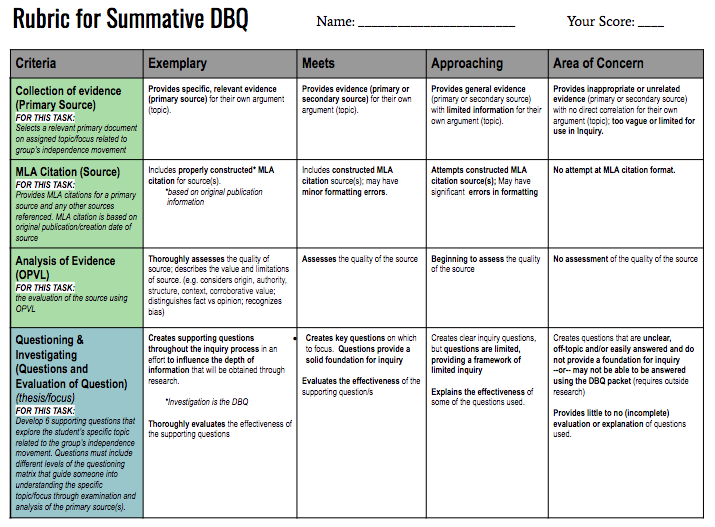
Evaluate the relevancy and effectiveness of your questions.
Finalize your INDIVIDUAL SUMMATIVE DBQ DOCUMENT.
Look over the rubric. Make sure your work reflects your highest quality of work.
​
Summative Due @ Start of Next Class
Picture

Comments are closed.

    Mrs. Stewart's Course

    You'll find a daily agenda posted here for each day that class meets

    Archives

    January 2026
    May 2020
    April 2020
    March 2020
    February 2020
    January 2020
    December 2019
    November 2019
    October 2019
    September 2019
    August 2019
    May 2019
    April 2019
    March 2019
    February 2019
    January 2019
    December 2018
    November 2018
    October 2018
    September 2018
    August 2018
    May 2018
    April 2018
    March 2018
    February 2018
    January 2018
    December 2017
    November 2017
    October 2017
    September 2017
    August 2017
    May 2017
    April 2017
    March 2017
    February 2017
    January 2017
    December 2016
    November 2016
    October 2016
    September 2016
    August 2016

    Categories

    All

    RSS Feed

Powered by Create your own unique website with customizable templates.
  • Home
  • AT Geography & Field Research
    • AT Geo: Daily Agenda
    • Geography 101: Intro to Geography
    • Unit 1: Inequalities
    • Unit 2: Demographics
    • Unit 3: Agriculture, Food & Health >
      • Community Health Webquest >
        • Water-borne pathogens
        • Vector-Borne Diseases
        • Pandemics
    • Unit 4: Urban Realm
    • Fieldwork
    • Country Portfolios
    • Geography Careers & Programs
  • World History 9
    • Daily Agenda - WH9
    • Unit 0: Thinking Like a Historian
    • Unit 1: Foundations of Civilizations
    • Unit 2: Revolution
    • Unit 3: Conflict
    • Unit 4: Globalization & Global Issues >
      • World History Voices Project - Students Digital Products
  • Social Studies/History Resources
  • AP Human Geography
    • Daily Agenda-APHG
    • APHG Unit 1: Geography: Nature & Perspectives
    • APHG Unit 2: Population & Migration
    • APHG Unit 3: Culture
    • APHG Unit 4: Political Geography
    • APHG Unit 5: Agriculture & Rural Land Use
    • APHG Unit 6: Industrialization & Economic Development
    • APHG Unit 7: Cities & Urban Land Use
    • APHG Exam Review
  • Free Time & Games
  • Current Events & Global Issues
  • About
  • Contact
  • Grade 7 Individuals & Societies
    • Grade 7 Daily Agenda
    • Grade 7 Weekly Homework
  • Grade 8 Individuals & Societies
    • Grade 8 Daily Agenda
    • Grade 8 Weekly Homework
  • CI MS Service-Learning
  • Photo Blog
  • SAS MS GIN Club